Deep Learning for Gravitational Wave Physics
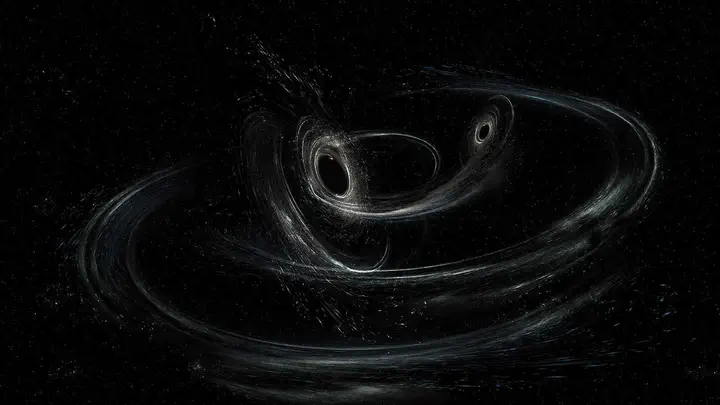 binary black holes
Within this project I worked as a research assistant at the Data Analytics Lab (ETH) in collaboration with physicists from the University of Geneve. We developed two deep learning models to better understand and simulate the complex physics behind gravitational waves produced by binary black holes. Specifically, we developed two models: (i) an emulator of cosmological simulations which makes stars evolve, eventually ending up in binary black holes, and (ii) an inverse-regression model to constrain the origin of gravitational waves in terms of black holes channel formation. As a first step, we pre-processed the available data and defined appropriate metrics in order to accurately account for the underlying physics. Then we investigated the complexity of the problem by studying the contributions of non-linear mappings and we optimized ad-hoc mlp regressors and classifiers. The emulator allowed to obtain accurate simulations orders of magnitude faster while the inverse-model allowed us to develop a pipeline for experimental data (e.g. LIGO). Lastly, we exploited the LIME framework and shapley values to provide physical insights on the results, specifically explaining the role of each feature towards the predictions. This allowed us to confirm what was expected from theory but also to build new useful intuitions.

Marcello Negri
PhD candidate
I am a PhD student in machine learning currently trying to make models more flexible and interpretable.